Selecting a refractory material is not about finding the “best” product. It is about matching the material’s properties to the specific operating conditions of the furnace – thermal, chemical, mechanical, and structural. The goal is singular: to ensure predictable and economically justified lining service life.
In this article we present a five-phase decision framework that helps you move systematically from analysing the operating conditions to choosing the lining configuration. The framework is built on PCO’s many years of experience designing linings for the steel, cement, lime, power, and foundry industries.
Note: the recommendations presented here are for educational purposes only and cannot serve as a direct basis for designing a lining. Every application requires an individual and comprehensive analysis that accounts for the operating conditions, the geometry of the equipment, its service history, and the process requirements. If you need to select the right material for your equipment, consult our engineering department – the contact form is at the bottom of the page.
Phase I: Operating Conditions Audit — Where to Begin Refractory Material Selection
Before you start reviewing product data sheets, you must precisely describe the conditions under which the lining will operate. This is the absolute foundation of material selection – without it, every material decision is guesswork.
Thermal profile
Identify the maximum operating temperature and how long it is held (the so-called soaking period – the longest possible time the lining will be held at a given temperature). Take into account every possible extreme scenario here.
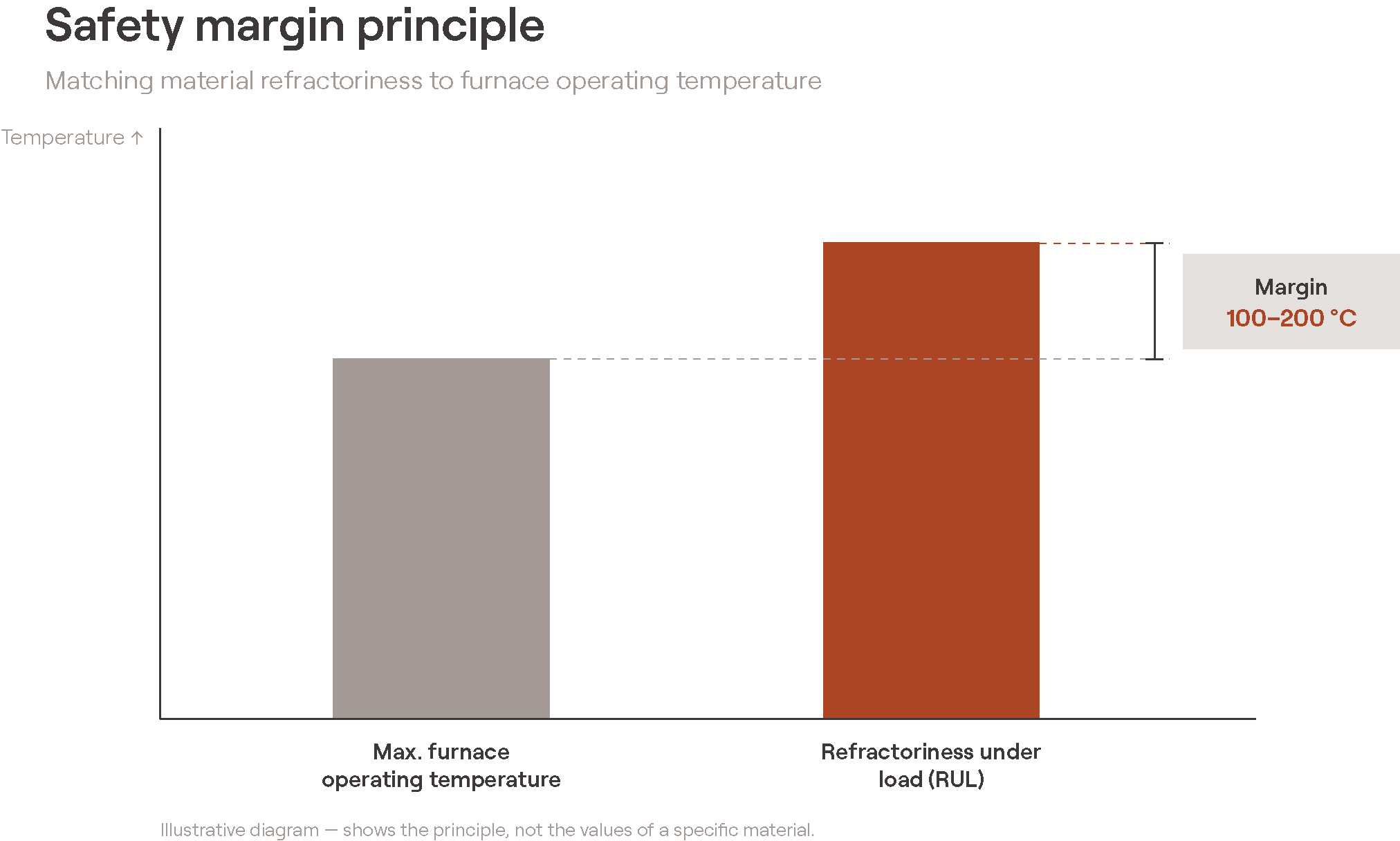
A practical rule of thumb: designers usually try to select a material whose refractoriness under load (ISO 1893) is roughly 100–200 ℃ higher than the maximum operating temperature. Of course, bear in mind that this rule is a generalisation and cannot be applied in isolation from the other operating factors – among them the atmosphere in which the lining works, since it can significantly affect the stability of the refractory material.
Furnace operating mode
Does the furnace run continuously (steady state) or cyclically (start-ups, shutdowns, temperature swings)? Equipment operating cyclically places far higher demands on thermal shock and spalling resistance. This is one of the most frequently underestimated factors – a material that performs perfectly in continuous operation can fail after just a few thermal cycles. That is why, for applications exposed to thermal shocks (rapid temperature changes) or frequent cyclic operation, it is worth analysing properties such as thermal expansion and resistance to sudden temperature changes.
When analysing a product’s parameters, always pay attention to the test method. Some properties have several testing standards and may therefore be determined under different conditions. For example, resistance to sudden temperature changes can be tested with water cycles (the material is cooled with water) or air cycles (the material is cooled with a stream of air). When comparing material properties, make sure you are comparing values determined according to the same test standard.
Chemical environment
Determine the chemical character of the environment in which the lining will operate. Will it be in contact with the process material – e.g. the charge, metal, or slag? Establish the chemical character of that substance – basic, acidic, or neutral? Identify the presence of corrosive gases (CO, SO₂, and alkali vapours are the usual concerns) and the character of the atmosphere – oxidising or reducing.
The process charge and the gases present in the equipment can react with the lining material, causing changes to its properties or corrosion. They can affect mechanical stability, thermal conductivity, and the heat capacity of the lining. Unfortunately, there is no single universal rule – the operating conditions of each specific piece of equipment must always be analysed.
Mechanical loads
Determine whether, and to what kind of, mechanical loads the lining will be subjected. For example, assess whether the material may be exposed to abrasion caused by the flow of process material or dust-laden gases. Analyse whether impact loads may occur at a given location (e.g. due to the flow of material). If a given lining element serves a structural role, it is worth considering what type of forces may act on it – all the typical actions may occur here: compressive, bending, shear, or tensile.
A material with very high compressive strength will not always be the right choice. In highly critical applications it is worth analysing not only the properties determined at room temperature but also those at operating temperature, as well as potential mechanical impacts (during charge flow or loading). In zones of intense abrasion or impact – such as charging windows or transition zones – abrasion resistance may be more important than refractoriness itself.
Phase II: Thermomechanical Properties — Which Properties Really Matter
Once the basic operating conditions are established, analyse the available materials in terms of the key mechanical and thermomechanical parameters. This is the stage at which the data sheet must be read with understanding – not all data carry equal weight.
Refractoriness Under Load (RUL)
In load-bearing zones this is a more reliable parameter than plain refractoriness (PCE). RUL indicates the temperature at which the material begins to deform under compressive stress – that is, under conditions closer to reality. In our experience, overlooking this parameter is one of the more common design errors.
Importantly, this parameter can differ for a given material depending on the atmosphere in the furnace (oxidising / reducing). The presence of corrosive agents also affects this property of the material. As a general rule, the higher the refractoriness under load, the more stable the material will be at high temperatures.
Apparent Porosity (AP)
In zones in contact with a material in a liquid or vapour state, look for materials with low apparent porosity. High porosity facilitates infiltration and the capillary transport of aggressive liquid phases deep into the structure, which accelerates corrosion from within.
Hot Modulus of Rupture (HMOR)
This is the true indicator of a material’s strength against bending stresses at operating temperature. “Cold” strength data (CCS, MOR) have limited design value – the mechanical properties of ceramics change significantly as temperature rises. It should be noted, however, that in many cases relying on parameters determined in room-temperature tests is entirely sufficient.
Abrasion resistance
Crucial in equipment with an intense flow of solids or high-velocity gases. Particularly important in the transition zones of cement kilns, flue-gas ducts, and cyclones. In such zones, high-alumina materials with enhanced abrasion resistance perform well – for example andalusite bricks such as Andalux and Abral
Phase III: System Configuration — Shaped Products or Castables?
The choice between shaped products (bricks) and cast products (refractory castables) is a system decision, not merely a material one. Both solutions are good – the art lies in matching them to the conditions.
| Criterion | Shaped products (bricks) | Monolithics (castables) |
| Geometry | More limited, due to the constraints of the forming process. | Flexibility – almost any geometry, with significantly fewer joints. |
| Installation speed | Can be slower and demand greater installer skill (especially where cutting is required). | The application itself (casting, gunning) can be faster than bricklaying, but it requires building formwork and stripping it after installation. |
| Drying process | Faster, less demanding. Water is introduced only with the mortar. | All the mixing water – both physically and chemically bound – must be removed. As a rule, reaching the appropriate temperatures is also necessary to achieve the target ceramic bond. |
Phase IV: Thermal Design — Balancing Insulation and Durability
High-temperature processes are highly energy-intensive and therefore costly. That is why the role of the lining is not only to act as a physical barrier for the process carried out in the equipment, but also to limit heat loss to the outside – in other words, to thermally insulate the process from its surroundings. This is where lightweight insulating materials come in, such as ISOLUX bricks. The insulation of high-temperature processes is, however, counter-intuitive and therefore treacherous.
Why over-insulation does harm
Adding or thickening an insulating layer raises the temperature inside the working lining. The consequences are serious:
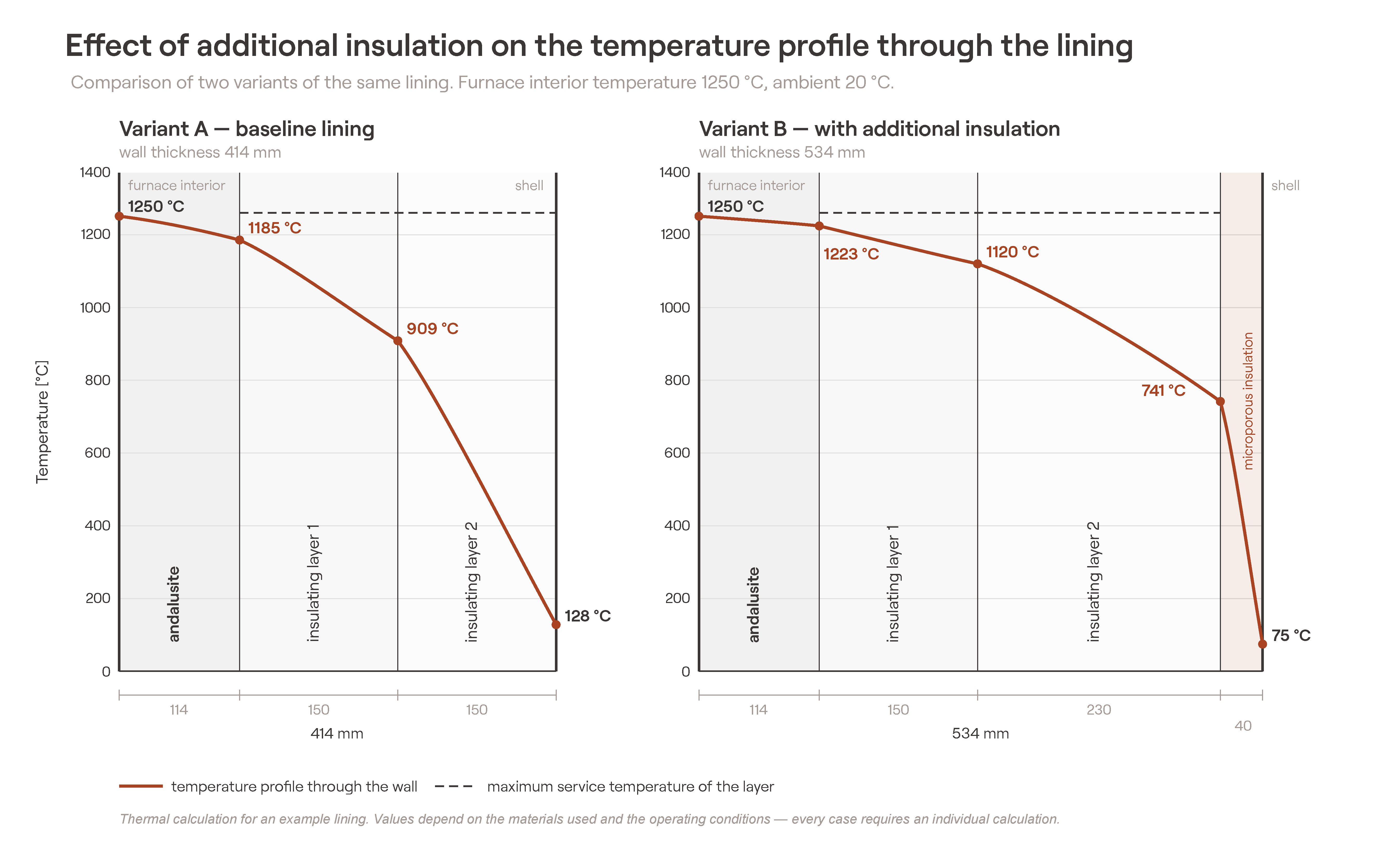
Reducing insulation thickness in critical zones. In zones of extremely high temperatures or intense corrosion, it is preferable to accept higher heat losses than to risk premature destruction of the working lining.
Creating a strong temperature gradient. This can be achieved by deliberately limiting insulation or by applying external cooling (air blast, water jacket).
Zonal cooling of critical spots. In tank furnaces, the lining belts at the glass-line level are often deliberately left without insulation and cooled with air, to weaken corrosion and erosion in this most heavily loaded area.
Techniques for preventing over-insulation
Reduce insulation thickness in critical zones. In zones of extreme temperature or intense corrosion, it’s better to accept higher heat losses than to risk premature working lining destruction.
Engineer a strong temperature gradient. This can be achieved by deliberately limiting insulation or applying external cooling (air blowing, water jacket). A strong gradient keeps the load-bearing outer portion of the wall in an elastic state — providing structural stability to the entire lining.
Zonal cooling of critical locations. In glass tank furnaces, the brick courses at the glass melt line are often deliberately left uninsulated and air-cooled to slow corrosion and erosion in this most heavily loaded area.
Verify temperature limits before installation. Before installing insulation, perform heat transfer calculations to verify that temperatures at the interfaces between layers don’t exceed allowable limits — both for the insulating materials and for the steel shell.
Particular caution when adding insulation to existing furnaces
Adding external insulation to equipment already in operation raises the temperature of all internal layers. This can lead to exceeding the thermal strength of intermediate materials, or cause overheating and creep of the steel structure. This is one of the most common modernisation pitfalls – a seemingly simple modification that can trigger a cascade of problems. That is why, when planning to modify equipment, it is always worth analysing the possible effects of the modernisation with a specialist refractory-lining designer.
Key Takeaways
- Refractory material selection is a systemic process – from the operating conditions audit, through thermomechanical properties and system configuration, all the way to the insulation design.
- Not every zone of a furnace requires the same material – the most heavily exposed areas need premium solutions, while economical materials suffice in less demanding ones. A deliberate choice lets you optimise costs without sacrificing durability.
- Insulation is a double-edged sword: too little = heat loss, too much = accelerated destruction of the working lining.
- Every application is different – a decision framework is a starting point, not a ready-made answer. Consulting an experienced engineer is not an option but a necessity.
Frequently Asked Questions
What is the difference between RUL and plain refractoriness (PCE)?
PCE indicates the softening temperature of a material without load. RUL indicates the temperature at which the material begins to deform under compressive stress – that is, under conditions closer to real operation. In load-bearing zones, RUL is the more reliable parameter.
Why does over-thick insulation shorten lining service life?
Additional insulation raises the temperature of the working layer. This accelerates chemical corrosion, pushes the thermoplastic zone deeper into the lining and – in rotary kilns – hinders the formation of a protective coating. More insulation does not always mean better.
Bricks or refractory castable – which to choose?
This is a system decision, not merely a material one. Bricks offer faster installation and drying; castables offer geometric freedom and fewer joints, but require formwork and careful drying. The choice depends on the geometry of the equipment, the operating conditions, and the available downtime.
How much higher than the operating temperature should a material’s refractoriness be?
A practical rule of thumb points to a margin of around 100–200 ℃ of refractoriness under load (ISO 1893) above the maximum operating temperature. This is a generalisation, however – the furnace atmosphere and the presence of corrosive agents can significantly change the actual requirements.