In brief: A leading European special-steel and forging mill (~120,000 t/year) had three problems at once in its bottom-pouring set: inclusions and cracks in the ingot, impurity pickup from the refractory, and a real breakout risk at the joints. PCO redesigned the set around the bauxite grade ALUTEX B80Lc (>80% Al₂O₃, low Fe₂O₃), with long tongue-and-groove connections on every joint and equalised tolerances across all shapes. The result: zero breakouts since implementation, smooth, clean runner channels, and less risk of impurities and micro-inclusions.
Roughly 97.5% of the world’s steel is continuously cast: it leaves the caster as slabs, blooms and billets and goes on to become coil, rails and bars. The remaining share is still cast the older way — poured into individual ingot moulds. Not out of habit. Heavy forging ingots and special, tool and high-alloy grades keep to the ingot route because it delivers the internal cleanliness and surface quality these products need. These ingots are bottom-poured.
The key to bottom pouring is the casting system: a set of refractory ceramic shapes packed into a steel casing and a casting plate, connected to the moulds. This is the hollow ware — the funnel, the guide tubes, the central block and the runner bricks — and every tonne of the heat flows through it on its way to the mould. The ingot is only as good as the ceramic the steel flowed through. The set has to do two things at once: withstand the casting conditions — roughly 1600 °C and up to an hour of flowing metal under a rising ferrostatic head — and give nothing up to the steel, because every particle the channels shed ends up in the ingot as a defect.
This article first walks through why refractory selection for the hollow ware matters so much — the wear mechanisms, the trade-offs, and the business consequences. Then it presents a real field case: a European special-steel and forging mill that moved its bottom-pouring set from a sintered mullite-type material to a low-iron bauxite grade and measured the difference in ingot cleanliness, refractory wear, and breakout risk.
If you specify refractories for an ingot shop, plan its shutdowns, or evaluate suppliers for hollow-ware sets, this one is written for you.
How bottom pouring actually works
In bottom (or “uphill”) teeming, liquid steel is not poured directly into the top of the mould. It pours from the ladle into a funnel, drops down a column of vertical guide tubes, and then travels horizontally and upward through a network of ceramic channels that fill each mould quietly from the base.
The flow path is a chain of refractory shapes — the assembled set is the hollow ware (sometimes called an ingot set), and the solidified steel skeleton left inside it after casting is the “bone” (or spider):
- Funnel: the receiving cone at the top of the set — the shape the steel stream from the ladle nozzle is actually poured into.
- Guide tubes (channel bricks): the vertical tubes below the funnel through which the steel flows down. They are stacked with tongue-and-groove ends for precise registry.
- Central block (king brick): the distribution hub at the bottom of the guide-tube column, with several off-takes that let one column feed multiple moulds at once.
- Runner bricks: the horizontal channels that carry steel from the central block to the base of each mould, ending in an end block under the mould stool.
Because the mould fills from below, the metal surface rises smoothly instead of splashing. That is the whole point: bottom pouring gives a superior ingot surface with far less reoxidation than top pouring, which is why it dominates in forging-grade, tool, and special steels where surface and internal quality are non-negotiable. It also lets a shop fill several ingots from a single teem — good for productivity, but it means one weak runner can spoil more than one ingot.
Why the hollow ware is where refractory choice bites
The hollow ware sees a brutal combination of conditions in a very short time. The steel arrives at roughly 1600–1650 °C (2910–3000 °F), moving fast and turbulent, and the channels must hold a rising ferrostatic head for the length of the teem — often close to an hour for large ingots — without softening or leaking. On top of that, the components go from ambient to full heat in seconds when the pour begins, so thermal shock on that first surge is a real failure mode.
Silica reduction by dissolved aluminium. In aluminium-killed steels, dissolved [Al] reduces silica in the refractory: SiO₂ + [Al] → Al₂O₃ + [Si]. This eats the refractory surface and generates large exogenous alumina inclusions that end up in the steel. It is the single biggest reason to keep free silica low in hollow ware for high-cleanliness grades.
Manganese oxide fluxing. MnO is a strong basic flux. It reacts with SiO₂ in the ceramic to form low-melting manganese silicates, which soften and are then physically washed away in the turbulent zones — exposing fresh refractory to further attack. High-manganese grades are especially aggressive.
Iron-oxide wetting. Fe₂O₃- and FeO-bearing phases wet the ceramic surface, aggravating both erosion and reoxidation of the steel.
For the person paying the bills, this translates into three concrete business risks:
The scale of the problem is well documented: in killed steels, roughly 60% of exogenous (macro) inclusions are attributed to chemical attack and fluxing of refractories — and erosion-derived inclusions tend to be larger, and therefore more harmful, than those from slag entrainment. Erosion concentrates wherever flow is turbulent, which is why the literature recommends keeping flow velocities in runner systems low, especially during the critical early stage of the teem.
- Dirty steel → rejects. Macro-inclusions and reoxidation products cause internal defects that show up in ultrasonic testing or during forging — scrapped or reworked ingots at full added-value cost.
- Breakouts → lost heats and safety events. A cracked runner or a leaking joint under ferrostatic pressure can breach the set mid-teem: a lost heat, an unplanned clean-up, and a genuine safety hazard.
- Refractory pickup → downgrade. Material torn from the lining becomes an exogenous inclusion in its own right — the opposite of the “zero pickup” that clean-steel customers demand.
The material menu for hollow ware
Refractory selection for the hollow ware is essentially a walk up the alumina–silica system, trading cost for chemical resistance and cleanliness.
| Grade family | Typical Al₂O₃ | Character in the hollow ware | Best fit |
| Fireclay | 30–42% | Cheapest, tolerant of thermal shock, but high SiO₂ reacts readily with [Al] and MnO | Simple / acid grades, small ingots, short teems |
| Sintered mullite | ~72% (mullite phase) | Low thermal expansion → very good thermal shock and creep resistance; less corrosion and infiltration than fireclay | Higher grades needing good surface quality |
| Fused mullite | ~72% (mullite phase) | Very low thermal expansion → outstanding thermal shock resistance; better corrosion resistance and less infiltration than sintered mullite or fireclay — but expensive | Higher grades needing excellent surface quality, where budget allows |
| Bauxite (fired or chemically bonded) | >80% | Higher alumina, lower free silica than mullite; low-iron grades give clean-steel performance and stronger breakout protection | Aggressive / zero-pickup grades, big ingots, high ferrostatic pressure, long teems |
Two nuances matter more than the headline alumina figure.
First, mineralogy beats raw chemistry. What resists erosion is the stability of the bond phase — the mullite matrix, the low-silica glass — not simply the total Al₂O₃ percentage. A high-alumina brick with an unstable, silica-rich bond can erode faster than a lower-alumina one with a clean matrix.
Second, the bond system changes how the shape behaves during the pour. Bauxite hollow ware is often chemically (phosphate) bonded rather than high-fired. Phosphate bonding gives the shape excellent handling strength, tight dimensional tolerances, and high abrasion resistance against the flowing stream — all valuable for a precisely registered tongue-and-groove set.
How to evaluate hollow-ware performance
Engineers judge hollow ware on the bench and on the casting floor, and the two have to agree.
On the bench, the key numbers are apparent porosity and bulk density (lower porosity resists metal infiltration, though some porosity is deliberately accepted for thermal shock tolerance and to insulate against premature freezing in the runners), refractoriness under load (RUL — will the runner hold its shape under the ferrostatic head?), permanent linear change (PLC — a slight positive value is often preferred, because a shape that expands a little keeps the joints tight), and thermal-shock cycles.
But the ultimate verdict is written on the bone — the solidified steel skeleton stripped from the set after casting. A used runner set is a post-mortem sample, and experienced people read it directly:
- Is the bone surface smooth and clean, with no refractory adhering to the steel? That means low reaction and easy stripping.
- Does a section through the runner show infiltration without reaction — steel that soaked into the pores but left the matrix intact, with no weak phases or cracks?
- Do ingot cleanliness tests (inclusion counts, micro-inclusion ratings) improve?
Lab metrics plus a clean bone plus cleaner ingots — that combination is what “good” looks like. It is also exactly what the following case delivered.
Case study: low-iron bauxite hollow ware for 42CrMo4 forging ingots
The operation
A leading European special-steel producer and forging mill, casting roughly 120,000 tonnes per year, runs a bottom-pouring ingot route for alloy forging grades. The reference case is a 42CrMo4 heat — a chromium–molybdenum forging steel where internal cleanliness directly governs the value of the finished part.
| Parameter | Value |
| Steel grade (reference) | 42CrMo4 |
| Casting temperature | 1630 °C |
| Ladle capacity | 50 t |
| Casting duration | ~1 hour |
| Ingot size | 800 kg |
Under these conditions — special steel, nearly an hour of metal contact — the runner is not a passive channel. It is an active source of inclusions, skull, and breakout risk, and three things in the set decide the outcome: material composition, shape tolerances, and the depth of the tongue-and-groove joints.
The initial situation: good intentions on bad joints
The shop had been running a sintered mullite-type hollow ware, and the symptoms were scattered across the whole process but pointed to one place — the ceramic:
- The material could not keep up with the steel. Mullite did not provide the corrosion and infiltration resistance this grade demands over an hour of contact.
- Defects travelled into the ingot. Non-metallic inclusions and cracks — some of them traceable to the refractory.
- The requirement was zero pickup. The ceramic must not contribute impurities (SiO₂, Al₂O₃ from the glassy phase) to clean-steel heats. It did.
- Breakouts lurked at the joints. The set used short tongue-and-groove connections with an undefined mix of tolerances between shapes. The components never assembled the same way twice — every build was a slightly different lottery of tightness under a full ferrostatic head.
One diagnosis, two fronts: a material mismatched to the steel, and joints too shallow to close the metal’s escape path.
The change
PCO rebuilt the set around ALUTEX B80Lc — its dedicated hollow-ware grade, engineered from a special composition of carefully selected low-iron bauxites (>80% Al₂O₃, deliberately low Fe₂O₃) — with two design changes made alongside the material switch:
- Long tongue-and-groove connections on all joints. Deeper registry lengthens the path metal would have to travel through the joint — simple geometry, a real drop in breakout risk.
- Equalised tolerances across every shape in the set, so funnel, guide tubes, central block, and runners assemble to a consistent, tight fit — repeatable instead of a lottery.
The grade itself is where the metallurgy is hidden. The raw-material base — a composition of selected bauxites with high alumina and minimal free silica — leaves the steel almost nothing to react with, while the deliberately low iron-oxide content removes a wetting and reoxidation source. On top of that sits a dedicated chemical bonding system, developed specifically for hollow ware: it locks the dense bauxite grains into an abrasion-resistant matrix that stands up to the flowing stream, holds tight dimensional tolerances shape after shape, and expands slightly on first heating — so the assembled joints grow tighter, not looser, at the exact moment the ferrostatic head arrives.
The material logic is the same as in any lining selection: the more aggressive the grade, the higher the cleanliness requirement, and the bigger the ingot, the higher you climb the alumina ladder (fireclay → mullite → bauxite). Higher alumina and lower free silica leave less SiO₂ available for [Al] and MnO attack; low iron oxide removes a wetting and reoxidation source and limits the low-melting phases that drive pickup.
Assembly on the casting plate
The set is assembled on the casting plate: the central block receives the stream from the guide tubes, and from it the runners radiate out to the end blocks under each mould. With equalised tolerances and the long tongue-and-groove, the shapes seat tightly and repeatably.
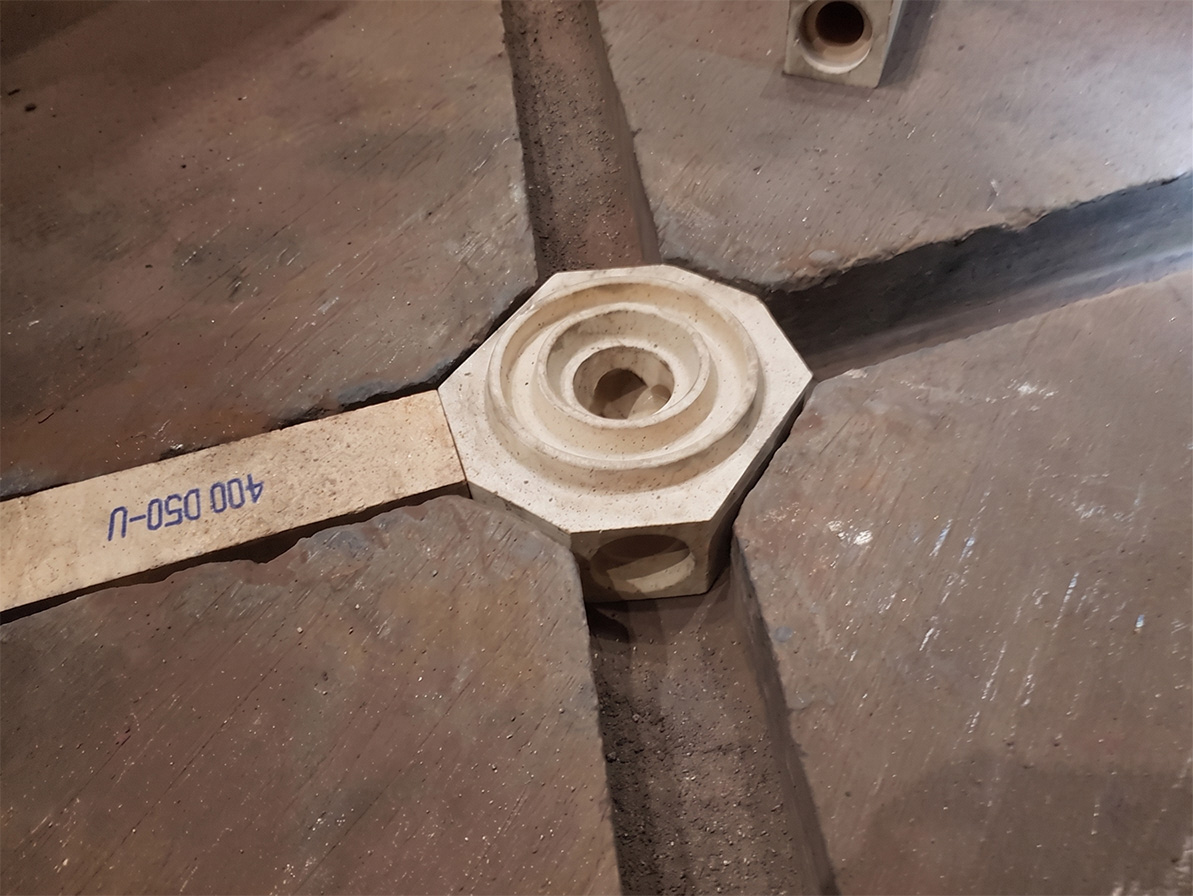
Central block (king brick) with a 400 mm runner during assembly in the casting plate.
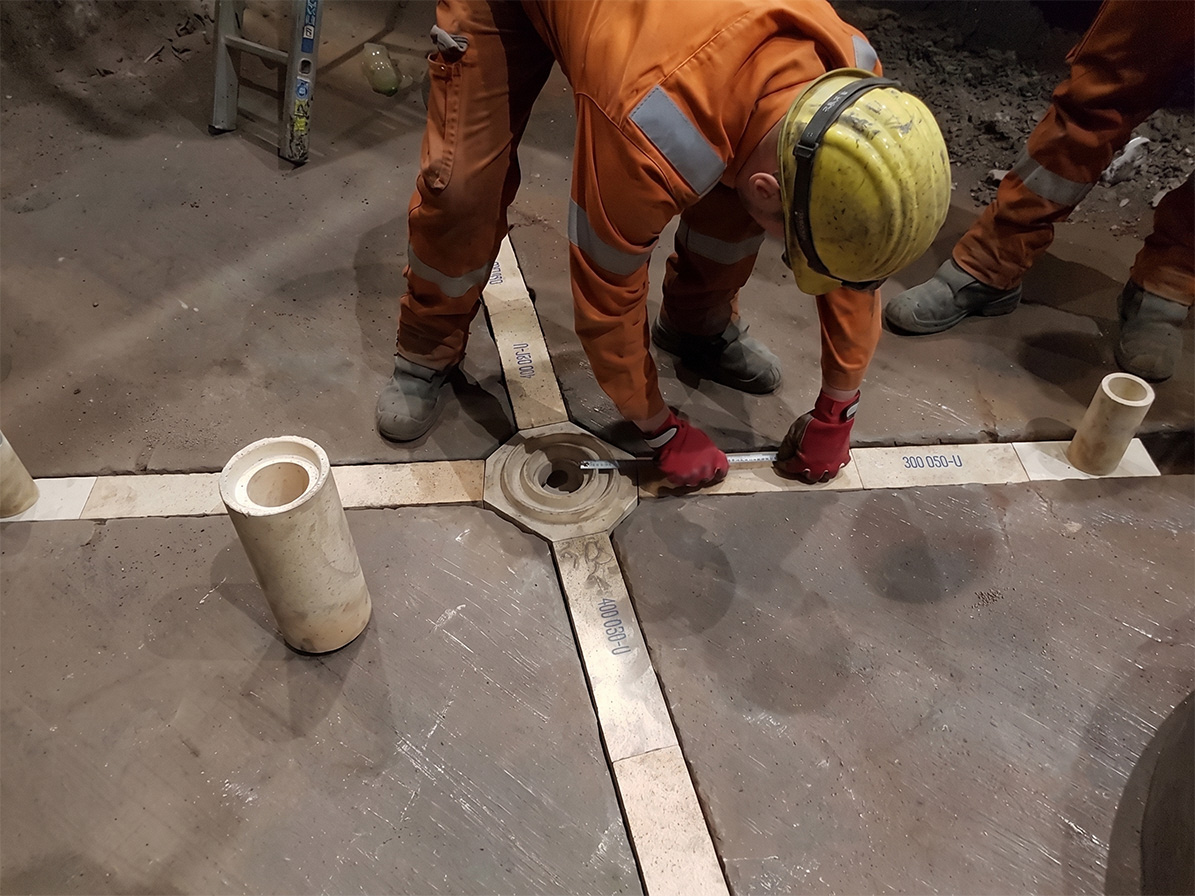
Set assembly: central block + 2 × 400 mm runners + end block on the casting plate
The results: the bones don’t lie
After casting, the most honest witness is the bone — the solidified steel stripped from the runner channels. Its surface is a direct imprint of what happened at the steel–ceramic interface. For the 42CrMo4 reference:
| What was assessed | Outcome with the bauxite set |
| Breakout protection | No breakouts since the material was introduced |
| Bone surface | Smooth and clean; no refractory adhering to the steel; used bricks and skull strip off without a fight |
| Joints / connections | Noticeably cleaner and tighter than the comparative solution |
| Runner cross-section | Infiltration to about 50% of the wall, but no refractory wear, no weak phases, no cracks |
| Ingot cleanliness (lab) | Fewer impurities and micro-inclusions in the tested ingots |
| Ingot quality | Improved overall |
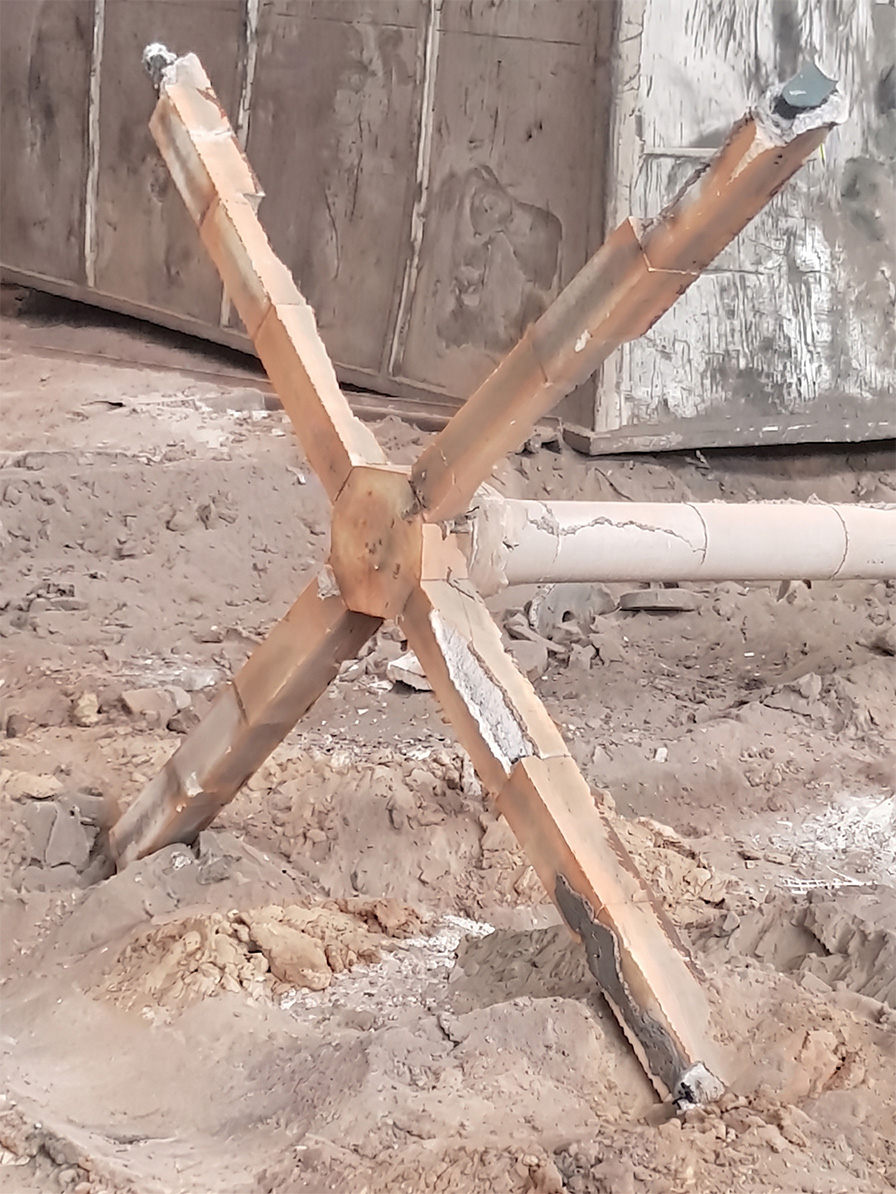
The complete steel skeleton (“bone”) on PCO shapes after casting.
The complete skeleton — even, uniform, with no growths or washouts. The set held its geometry through the entire teem.
Contact surface between PCO refractory and bone, close to the central block
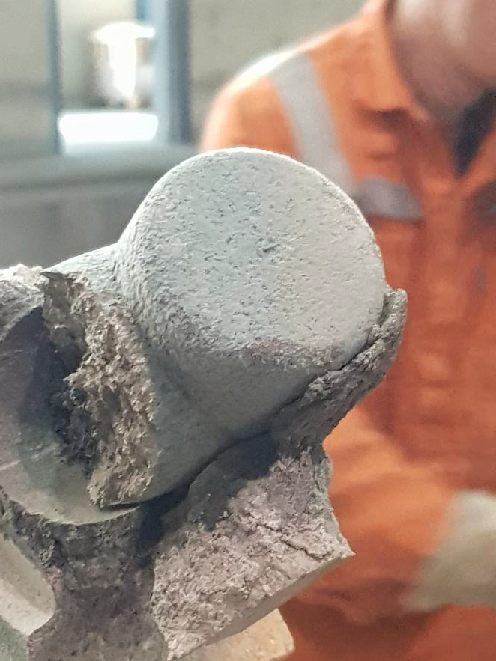
Bone surface at the end runner.
The cast skin is smooth and clean, and the refractory separates from it along a sharp, well-defined boundary. The steel did not bond with the ceramic — and took nothing from it.
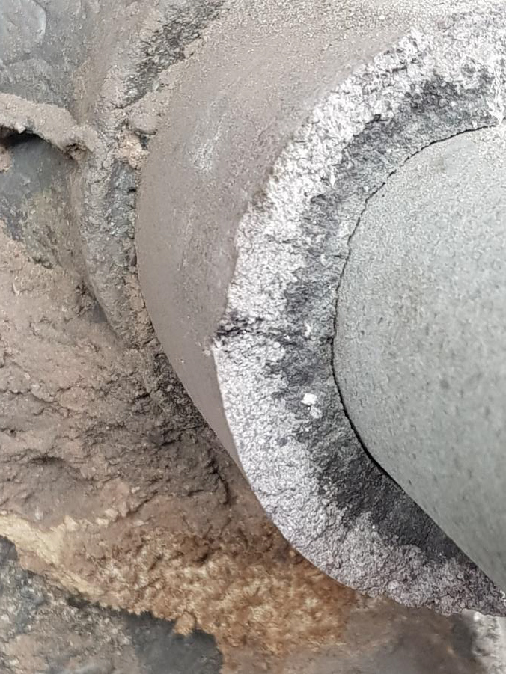
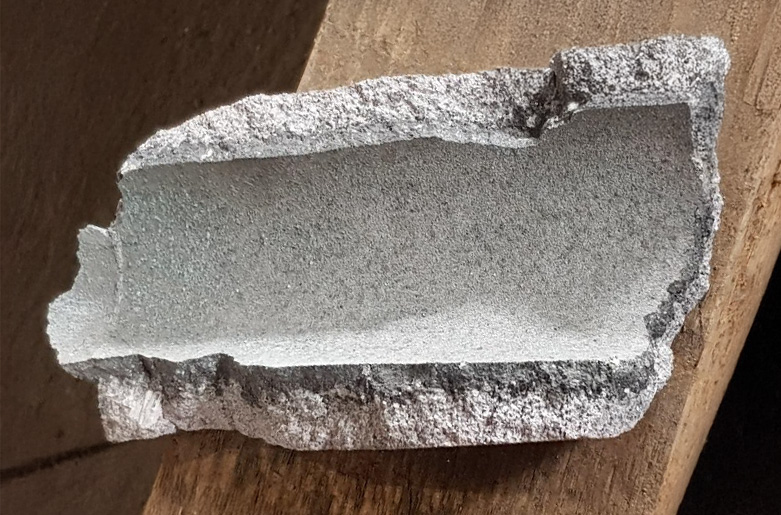
Section through the steel infiltration zone in a PCO runner.
The most telling result is that seemingly worrying line in the table: steel soaked roughly half-way into the runner wall — paired with the fact that it did no harm. The infiltrated zone is compact, with no cracking or crumbling. Controlled infiltration, not destruction. What matters is not whether the steel penetrated, but whether it broke anything: infiltration without reaction is acceptable; reaction is what tears refractory into the steel and eats the runner.
And here is the same location when the material cannot keep up with the steel — the comparative solution:
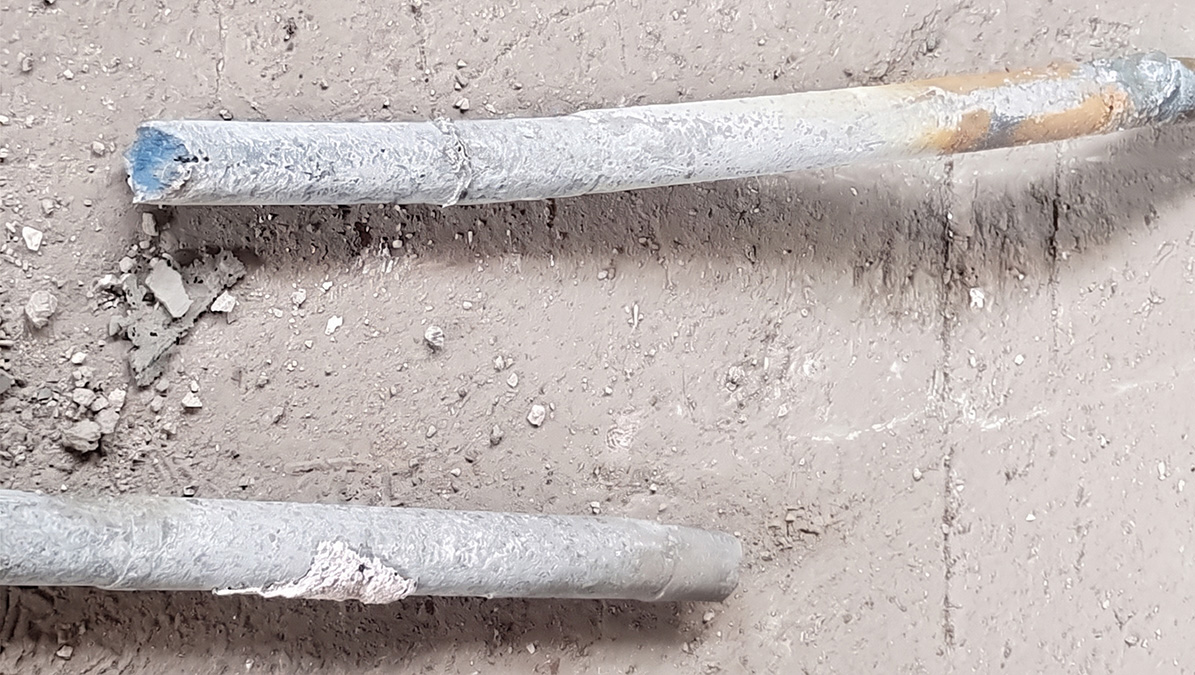
Bones from the comparative material.
Compare the surfaces. The comparative bones are uneven, rough, and locally thinner, with adhering refractory and rust-orange deposits along the surface. That is not cosmetics — it is the record of a reaction between ceramic and steel. A rough skin and adhering residue mean the material was being picked up by the metal and reacting with it; the discolouration is the product of that reaction — low-melting phases and oxides bound to the cast surface. Every such point on the ceramic–steel boundary is a potential non-metallic inclusion carried into the ingot. In other words: the bones show exactly what the laboratory later finds in the metal.
Why it worked
Every result traces back to the material and design logic. Cleaner steel came from the chemistry: bauxite at >80% Al₂O₃ carries less free silica than the previous mullite (~72%), and the grade’s low Fe₂O₃ removes a wetting and reoxidation source — so less of the SiO₂ + [Al] reaction, less MnO fluxing, fewer erosion-derived inclusions, and no measurable pickup. No breakouts came from the mechanical redesign plus the material’s behaviour: the long tongue-and-groove joints and equalised tolerances close the leak paths, while the chemical bond and the slight expansion on heating keep the assembled joints tight under the ferrostatic head. Easy stripping and a clean bone came from low reactivity — the refractory simply does not bond to the solidified steel.
None of this makes bauxite the universal answer. For simple or acid grades, small ingots, and short teems, fireclay or mullite may be perfectly adequate and more economical. The point of the case is narrower and more useful: for aggressive, clean-steel grades, big ingots, high ferrostatic pressure, and long casting times, a low-iron bauxite hollow ware buys measurable cleanliness and breakout margin that a silica-richer material cannot.
Key takeaways
- In bottom pouring, the hollow ware — not the furnace — is the refractory that decides ingot cleanliness and breakout risk; roughly 60% of exogenous inclusions in killed steel come from refractory attack.
- The wear is chemistry-driven: dissolved [Al] reduces SiO₂, MnO fluxes silica, and Fe₂O₃ wets and reoxidises. All three point the same way — lower free silica and lower iron oxide for clean grades.
- Fireclay → mullite → bauxite is a walk up chemical resistance and cleanliness. Match the grade to the steel, ingot size, and teem length rather than defaulting to the cheapest or the highest alumina.
- Joints are a failure mode of their own: deep tongue-and-groove registry and equalised tolerances are as much a part of breakout protection as the material.
- Read the bone: a smooth, clean, easily stripped skeleton with infiltration-but-no-reaction is the field signature of a well-matched material.
- In the case shown, switching a mullite set to low-iron bauxite (ALUTEX B80Lc) with a longer tongue-and-groove design delivered fewer micro-inclusions, zero breakouts, and clean stripping on 42CrMo4 forging ingots.
Frequently asked questions
Is mullite good enough for bottom pouring special steels?
For high cleanliness requirements and long casting times — choose bauxite. Higher Al₂O₃ gives greater resistance to corrosion and infiltration, and low Fe₂O₃ limits low-melting phases and impurity pickup. Mullite remains a sound choice for higher grades without such strict cleanliness demands; fireclay for simple steels and small ingots.
Does a longer tongue-and-groove joint really reduce breakouts?
Yes. Deeper registry lengthens the path metal would have to travel through the joint, and combined with equalised shape tolerances it produces repeatably tight connections. It is a physical closure of the escape path, not cosmetics.
Steel infiltrated ~50% of the runner wall — is that a reject?
Infiltration depth alone does not decide. If, despite the penetration, the material shows no wear, no weak phases, and no cracks, it is working in a controlled way. Judge the integrity of the structure, not the depth of soak.
How do I know the runner material is “dirtying” the steel?
From the ingot and from the bones: elevated inclusion and micro-inclusion counts in testing, refractory residue adhering to the channel surfaces, skull that is hard to remove. Bones that strip clean and smooth are the signal that the ceramic is not giving up impurities to the metal.
Related PCO solutions: PCO manufactures the full hollow-ware range for bottom-pouring sets — including chemically bonded Alutex B80Lc — and supports customers with set design (tongue-and-groove geometry and tolerancing), installation, and post-mortem bone analysis to pin down wear mechanisms on real used shapes, Technical support.
Struggling with inclusions, pickup, or breakouts in bottom pouring? PCO will help you select and design a hollow-ware set for your specific steel grade, ingot size, and casting time. Get in touch with our technical team